What Is Point in Line in Saber Fencing?
Published on Saber Nation:
Point in line is a straight-arm threat that owns priority until the attacker deflects the blade. How FIE and USA Fencing define it in saber, and what happens when both lights come on.
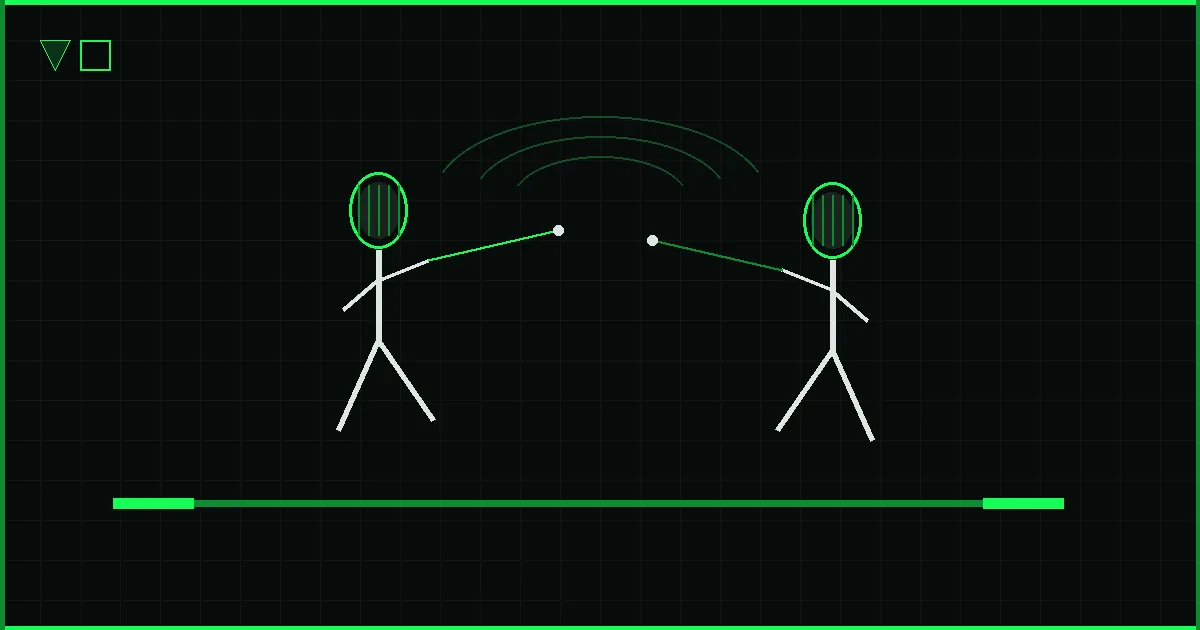
Point in line in saber fencing is a straight-arm threat that can own right-of-way until the attacker removes it. USA Fencing’s glossary defines point-in-line as an action in which the fencer, generally out of attacking range, points the weapon at the opponent with the arm fully extended — and says the fencer who establishes it has right-of-way until the opponent removes the blade by executing a beat (USA Fencing Glossary).
That short definition decides a lot of simultaneous lights.
The rulebook definition
The FIE Technical Rules (August 2026) define the position in t.15: the sword arm is kept straight and the point of the weapon continually threatens the opponent’s valid target (FIE Technical Rules PDF; rules index at fie.org).
USA Fencing’s competition rules use the same t.15 language for domestic events (USA Fencing Rules for Competition, Nov 2025 PDF).
Two setup rules matter before the phrase even starts:
- t.22.5 — when fencers are put on guard during the bout, distance must be such that in the point-in-line position the points of the two blades cannot make contact.
- t.22.13 (FIE numbering; USA Fencing t.22.12) — at foil and sabre, fencers may not come on guard in the in-line position.
You establish the line after “Fence,” not as your starting pose.
What the attacker must do
Under saber conventions t.102.1, if the attack starts when the opponent has point in line, the attacker must first deflect that weapon. Referees must ensure that a mere contact of the blades is not enough (FIE Technical Rules).
If the attacker tries to find the blade, misses it (dérobement), and keeps going, the right of attack passes to the opponent (t.102.2).
That pairs with the beat rules in t.104: a correct beat on the foible can clear the line and keep your attack; a beat into the forte can hand the immediate riposte to them. For how foible vs forte is judged, see our beat attack guide.
When both lights come on
FIE t.106 is the saber judging checklist. Two line-related calls show up often:
Situation — Who is usually hit
Attacker starts into an established line without a real deflection (t.106.4.a) — The attacker
Line holder gets beaten/taken, then re-attacks or re-sets line instead of parrying the direct hit (t.106.3.e) — The line holder
In plain strip language: establishing the line is not a free pass forever. If they clear your blade and continue, you must defend — usually with a parry-riposte — rather than re-planting the point and hoping the referee still sees “your line.”
USA Fencing’s Basics of Competition page also stresses that when both scoring lights fire, the referee decides who owned the attack. Point in line is one of the clearest ways that ownership is assigned before the final cut lands.
What point in line is not
- Not a bent-arm invitation. A soft, angled point that does not continually threaten valid target is not the t.15 position.
- Not an on-guard pose. Foil and saber fencers may not start the phrase already in line (t.22).
- Not a substitute for distance. You still need the point on target when the box locks. A pretty line that never lands still loses a one-light phrase.
- Not the same as a compound attack or second intention. Those are offensive constructions. The line is a threat position that forces the other fencer to deal with your blade first.
How to train it without inventing habits
- Static line. Partner advances. You hold a true straight-arm threat. They must find and deflect before finishing.
- Dérobement. Partner tries a soft beat. You disengage the point (not the whole arm) and continue. Feel priority change when the beat misses.
- Clear-and-finish. You are the attacker. Partner holds line. Beat foible, then finish without pausing — the continuous attack FIE expects under t.101.
- After the beat. Partner clears your line with a real beat. Your job is immediate parry-riposte, not a late re-line.
Film the arm. If the elbow bends as soon as pressure comes, referees stop seeing “in line.”
Watching the call at tournaments
Listen for phrases like “attack into the line,” “beat, attack,” or “no deflection.” Those map to t.102 and t.106, not club folklore. For calendars and rule updates that affect how these phrases are called at NACs, use our USA Fencing news hub and the tournament schedule.
Train the line in Bethesda
Saber Nation is a saber-focused club at 4701 Sangamore Road, Suite LL2, Bethesda, MD. We work point in line, beats, and referee-readable phrases in group classes and private lessons. Questions about a first session? Contact us.
Sources: USA Fencing Glossary — Point-in-Line; USA Fencing Basics of Competition; FIE Technical Rules (August 2026) PDF (t.15, t.22, t.101–t.106); USA Fencing Rules for Competition (Nov 2025) PDF.