What Is a Flunge in Saber Fencing?
Published on Saber Nation:
A flunge in saber fencing is the legal explosive forward attack after the FIE banned the crossed-leg flèche. How USA Fencing defines it, what t.101.5 forbids, and when coaches teach it.
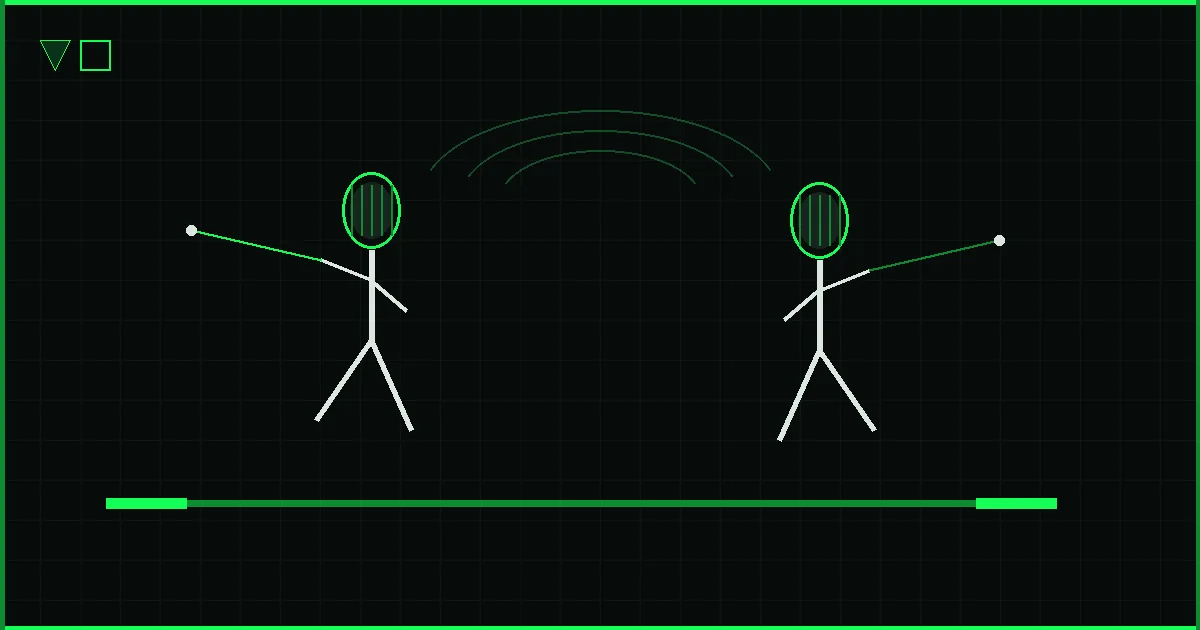
A flunge in saber fencing is the saber-specific explosive forward attack that replaced the running flèche after the FIE banned crossed-leg forward movement in the weapon. USA Fencing’s glossary defines it as “a combination of a lunge and a fleche” that “evolved recently after the FIE modified saber rules in 1992 to prohibit running attacks” (USA Fencing glossary).
If you already know the lunge and right of way, the flunge is how saber closes distance fast without committing a cardable flèche.
Flèche vs flunge
USA Fencing’s glossary draws a clean line:
- Flèche: “Explosive, running attack (Foil and Epee only).”
- Flunge: “Action unique to saber — a combination of a lunge and a fleche.”
In foil and épée, a running flèche is legal when done within the conventions of fencing. In saber, the same crossed-leg run is not.
What the FIE rules forbid
Under the FIE Technical Rules (August 2026), saber article t.101.5 states:
The fleche and any forward movement in which the rear foot completely passes the front foot is forbidden. Any offence will be penalised as specified for penalties in the 1st group (cf. t.158-162, t.165, t.170). Any hit scored by the fencer at fault will be annulled. However, any hit correctly executed by his opponent is valid.
Source: FIE Technical Rules, August 2026 (t.101.5). The FIE index labels this “Forbidden (flèche and forward movement crossing legs at sabre).”
So the bright line is footwork: if the rear foot completely passes the front foot during the forward action, the attack is a flèche-style offense in saber. Your light can come on and still be annulled, and you take a 1st-group penalty.
How a correct saber attack is supposed to look
The same saber chapter (t.101.2–4) ties a correct attack to arm extension before the lunge, and to the hit arriving no later than when the front foot lands on the piste for simple and compound lunging attacks. That is the legal explosive option: extend, drive off the back leg, land the front foot, finish the cut or thrust — without the rear foot overtaking the front.
Coaches call the legal high-speed version a flunge. The rulebook does not use the word “flunge”; the glossary does. On the strip, referees enforce t.101.5, not slang.
Why continuous crossed steps also lose priority
Separate from the flèche ban, FIE foil conventions (applied where the phrase rules overlap) treat “continuous steps forward, with the legs crossing one another” as a preparation, and “on this preparation any simple attack has priority” (t.84.3 in the August 2026 Technical Rules). In plain terms: a running cross-step sequence is not a finished attack. Your opponent can launch a simple attack into that preparation and own the phrase.
For saber families learning how to watch a bout, that is why a referee sometimes gives the touch against the fencer who “looked faster” but crossed feet or started with a bent-arm shuffle.
When fencers use a flunge
Common situations:
- Closing from mid-strip when a normal advance-lunge would land short
- Finishing after preparation that drew a late parry
- Hitting on the break of distance when the opponent retreats hard
It still has to satisfy attack rules: arm straightening and a continuous threat of the cutting edge or point before the explosive footwork. A bent-arm dive with crossed feet is both a preparation problem and a t.101.5 problem.
Training notes for Bethesda saber
Drill the flunge only after the ordinary lunge recovers cleanly under fatigue. Most beginners need footwork and a reliable parry-riposte before they need a flunge. When you do add it, film from the side so you can see whether the rear foot ever passes the front.
For national weekends and rule updates, use USA Fencing news and the tournament schedule.
Saber Nation is a saber-focused club in Bethesda at 4701 Sangamore Road, Suite LL2. Private work on distance and finishing actions is available through private lessons, or contact us with questions.