Yellow, Red, and Black Cards in Saber Fencing: What Each Penalty Means
Published
Fencing penalty cards explained for saber: yellow warning, red penalty touch, black exclusion, plus P-cards for non-combativity — with USA Fencing and FIE cites.
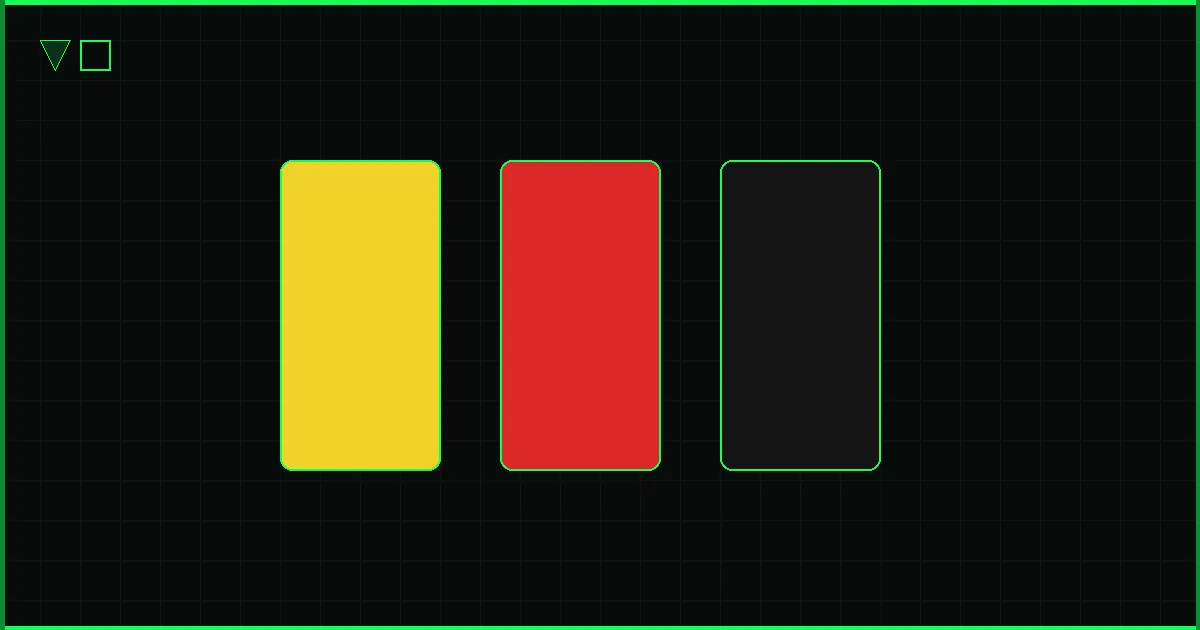
Yellow, Red, and Black Cards in Saber Fencing: What Each Penalty Means
A referee holds up a colored card mid-bout. Parents freeze. Fencers already know the code. Fencing penalty cards are how USA Fencing and the FIE keep order on the strip — and they work the same way in saber as in foil and épée.
USA Fencing’s Basics of Competition groups infractions into four categories. The FIE Technical Rules (August 2026) define what each color does in articles t.158–t.163 (FIE Technical Rules PDF). The November 2025 USA Fencing Penalty Chart is the one-page map referees keep at the strip.
Yellow card: a warning that sticks for the bout
FIE t.162.1: a yellow card is a warning. The referee identifies the fencer at fault. Any further offense from that fencer in the same bout costs a penalty touch (FIE Technical Rules PDF).
USA Fencing Category One penalties are interdependent. First Category One offense in a bout: yellow. Any additional Category One offense in that bout: red, and the opponent gets a penalty touch (Basics of Competition).
The November 2025 chart lists Group 1 examples parents see often: leaving the strip without permission, turning the back to the opponent, covering or substituting valid target, delaying the bout, and — saber-specific — a touch scored with the guard, or a forward movement that crosses the legs or feet (t.96.3, t.101.5 on the chart) (USA Fencing Penalty Chart).
Yellow cards are noted on the score sheet with their group (FIE t.163). They do not add a touch by themselves.
Red card: a penalty touch for the other fencer
FIE t.162.2: a red card awards a hit to the opponent. If that touch would end the bout, the bout ends. After a red card, the next sanction is another red or a black, depending on the offense — not another yellow (FIE Technical Rules PDF).
USA Fencing Category Two offenses start at red on the first occurrence. Category One and Two offenses also annul a touch the offending fencer scored while committing the foul (Basics of Competition).
Group 2 examples on the November 2025 chart include using the non-weapon arm or hand, absence of an equipment-control mark, and dangerous or violent action with the guard or pommel (USA Fencing Penalty Chart).
Black card: exclusion from the competition
FIE t.162.3: a black card means exclusion from the competition, suspension from the rest of the tournament, and a 60-day suspension in the active season (FIE Technical Rules PDF).
USA Fencing Category Four covers unsportsmanlike conduct, fraudulently modified equipment, collusion, and brutality — automatic black (Basics of Competition). Category Three (safety and order) can land as red or black depending on the case.
The November 2025 chart’s Group 4 list includes falsified inspection marks, intentional equipment modification, refusal to salute, and doping (USA Fencing Penalty Chart).
P-cards: the separate non-combativity track
Unwillingness to fight uses its own P-yellow, P-red, and P-black cards. Those P-cards are not cumulative with ordinary yellow/red/black sanctions (USA Fencing Penalty Chart).
USA Fencing’s December 2022 update (effective January 1, 2023) explains the sequence for a minute of non-combativity: first time P-yellow to both fencers, second time P-red, third time P-black, and the bout ends under the published scoring rules. P-cards stay inside that bout or team match — they do not carry to the next one (Updated Unwillingness to Fight rules).
What this means on a saber strip
Cards are not “attitude points.” They are a published schedule. Ordinary Group 1 mistakes start yellow. Repeat them and the opponent’s score ticks up. Serious safety or integrity breaches skip the warning and go straight to red or black.
If you are learning saber in Bethesda, ask your coach which Group 1 fouls show up most in local Capitol Division pools. Knowing the chart before your first rated event saves more points than memorizing every article number.
For more on how priority decides the touch when both lights fire, see our guide to right of way in saber fencing. For bout timing and the 8-touch break, see how long a saber fencing bout lasts.
Saber Nation Fencing Club trains saber in Bethesda, MD. Private lessons and group classes are at 4701 Sangamore Road, Suite LL2 — ask about private saber lessons if you want referee-style feedback on strip habits before your next tournament.
Related guides
Train saber in Bethesda
Saber Nation is a dedicated saber club led by Owner and Head Coach Fikrat Valiyev at 4701 Sangamore Road, Suite LL2, Bethesda, MD 20816.