Saber Fencing for Kids: Reaction Time, Fitness, and What the Research Shows
Published
Saber fencing for kids trains reaction time, coordination, and fitness in short, fast exchanges. Here is what USA Fencing, the FIE, and peer-reviewed studies actually show about how young fencers get faster.
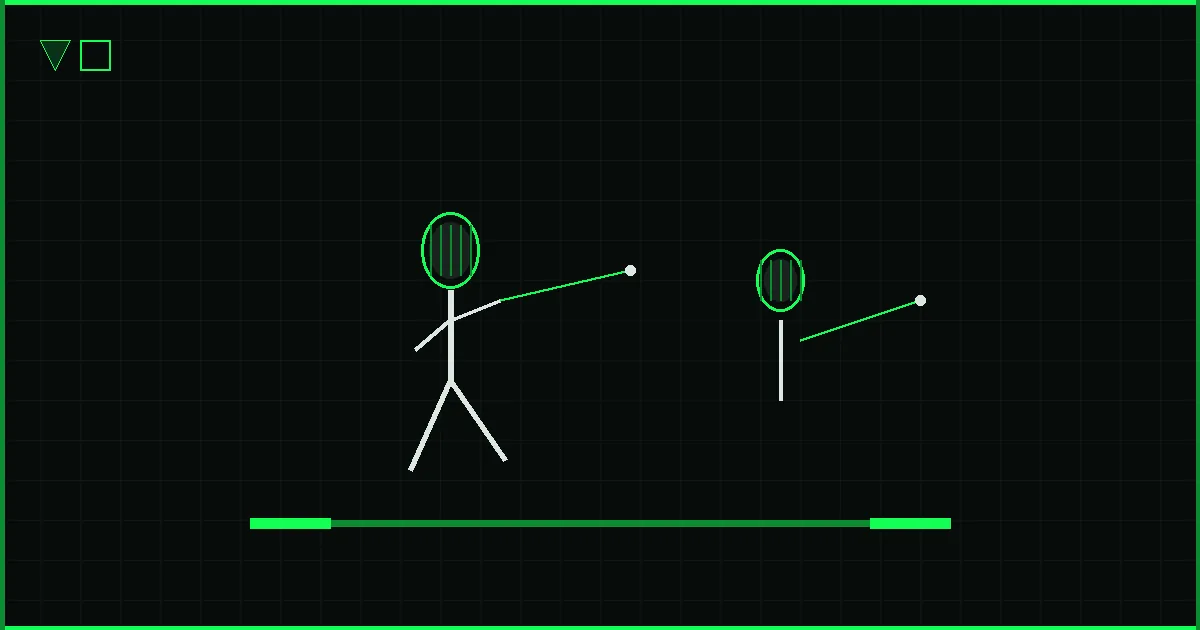
Saber fencing for kids is a high-tempo Olympic sport with a light cutting blade and a large target. The FIE’s Rio 2016 sabre guide lists a weapon under 500 g and no longer than 105 cm. Hits count with the tip or the cutting edge. Valid target is everything above the waist, including the head and both arms. That mix — light blade, big target, right of way — is why a kids saber bout is a string of short decisions, not a long rally.
USA Fencing puts fencing among five sports contested at every Olympics since 1896, with athletics, cycling, swimming, and gymnastics. Direct-elimination bouts go to 15 touches. Pool bouts go to five. In saber, USA Fencing’s beginner page says the first period runs to eight touches, then the bout continues until someone reaches 15. The strip is about 46 feet long. For a child, that is a lot of start, stop, and react in a small space.
Kids do not get faster the way adults do
USA Fencing’s athlete-development articles, written with SPIDERfit Kids, are blunt about this. Before puberty, speed gains come from motor coordination, not from training an adult anaerobic system. Children have up to 60% less muscle glycogen than adults. Their sweat glands produce about 40% of an adult’s output. Walking or running costs about 20% more oxygen. They fatigue fast in high-intensity work and need short bouts with little rest between them.
The same series places a useful window between about ages 6 and 12, when motor-coordination regions of the brain are developing quickly. Myelination, which makes neural signals travel more efficiently, is described as ramping up around ages 7–8. Vision is still catching up: the macula, which helps close-up focus, is described as forming around age 6, and the eyeball as reaching a rounder shape around age 9. That is why a seven-year-old on the strip can look uncoordinated one month and cleaner the next. They are paving the neuromuscular roads, not packing on adult power.
The coaching implication is practical. USA Fencing tells coaches to keep kids’ activities short, emphasize doing the movement correctly, and skip fatigue-for-fatigue’s-sake. “Speed camps” and gadgets are the wrong tool. Play, varied movement, and patient repetition are the right ones.
What the studies on young fencers actually measured
A 2020 paper by Bulent Turna in the Journal of Education and Learning (doi:10.5539/jel.v9n1p127) tested 48 licensed fencers, 24 girls and 24 boys, ages 11–14. Half added active-reactive agility drills twice a week for six weeks. The other half kept conventional fencing training. In the agility group, simple reaction time on a Favero electronic target fell from 0.46 seconds to 0.42 seconds. Multiple-target reaction time fell from 1.77 seconds to 1.66 seconds. Illinois agility time improved from 20.43 seconds to 19.68 seconds. In the conventional group, simple reaction time stayed at 0.49 seconds. The study used an épée tip on the electronic target, so it is a youth-fencing result, not a saber-only one. It still matches what saber coaches see: extra reactive agility work moved reaction time. More of the same lesson did not.
A 2025 randomized trial in BMC Sports Science, Medicine and Rehabilitation (doi:10.1186/s13102-025-01186-3) enrolled 22 recreational fencers with a mean age of 11.6 years. Eleven did eight weeks of Life Kinetik sessions — one hour, twice a week — mixing motor tasks with cognitive ones. Eleven did not. The training group improved on the Stroop test by 9% (reading), 14% (color naming), and 7.5% (interference). The control group changed by 0.5%, 1%, and 1%. Agility, countermovement jump, and Y-balance also improved in the training group (p < 0.001). Knee-position proprioception did not. The authors’ own limit is useful: this kind of brain-and-body work helped general athletic and cognitive scores. It was not a substitute for fencing-specific skill.
For saber itself, USA Fencing summarized an October 2025 paper by coach İrem Ülkü and Barış Baydemir. They tested 33 competitive male saber fencers, average age 12, on agility, sit-and-reach flexibility, 2-meter lunge speed, and vertical and horizontal jumps. Fencers who scored better on agility also jumped higher. Higher sit-and-reach scores lined up with slower lunges. USA Fencing states it did not independently review the study. The coaching takeaway they chose to publish is still conservative: young saber athletes need agility, jump work, and balance alongside bladework, and stretching without that mix is not a performance plan.
Safety, ages, and what parents do not need to buy
USA Fencing calls fencing one of the safest Olympic and Paralympic sports because of mandatory protective gear and rules that prohibit body contact. That is the national governing body’s claim. It does not publish a comparison number on that page, so there is no injury-rate statistic to quote here.
Competition ages for 2026–27 are set by birth year. USA Fencing lists Y8 (born 2018–2020), Y10 (2016–2019), Y12 (2014–2017), and Y14 (2012–2015), then Cadet and Junior. A child can fence up a category in some cases if they already appear in a national age-group point standing. Y10 weapons, all three blades, may not exceed 32.5 inches. Masks must pass a 12K punch test.
FIE-labeled uniforms are not required. In a May 2025 USA Fencing parent mailbag, Greg Husisian notes that USA Fencing rules do not require FIE equipment at any level. FIE jackets and knickers are described as passing an 800 Newton piercing test; typical non-FIE kit is about 350 Newton. For a Y10 fencing other Y10s, that extra rating is not a safety rule. Kids outgrow jackets fast. A parent mailbag example in the same piece is worth keeping in view: a last-place Y12 North American Cup result did not predict later results. Two athletes from the bottom of that event later stood on a Junior World Championship podium. Early rankings are noisy. Habits and whether the child likes practice are the better early signals.
USA Fencing’s Youth Bill of Rights says children get to fence as children, not as small adults, at a level that matches development, in a safe environment, and to have fun. That is policy language, not a slogan from a club brochure.
In April 2026 USA Fencing launched En Garde!, a free school program. The elementary level (grades 3–5) uses foam foils. One of its four pillars is “Mind + Body”: critical thinking, reaction time, and strategic decision-making next to fitness. School intro is often foil. A saber club is the next step for families who want the cutting weapon.
What a kids saber class should look like
USA Fencing’s kids warm-up article argues against opening practice with jogging laps and toe-touches. Static stretching is better after practice. A usable block for 6- to 10-year-olds is about five minutes: short general coordination tasks, then sport-specific acceleration, deceleration, direction change, and reaction. That maps cleanly onto saber. Advance, retreat, stop, go, and answer a visual cue.
Put the research next to a class and the picture is consistent. Keep work bouts short. Teach the action correctly instead of grinding tired kids. Mix footwork with tasks that force a choice. Treat agility and jump work as part of saber, not as optional gym time. Do not chase adult speed methods before puberty.
Saber Nation’s Bethesda group classes follow that age split: Little Sabers for ages 5–8, Youth Development for 8–14, and a Competitive Track from age 9. Equipment is lent to beginners.
Saber fencing for kids will not turn a seven-year-old into a miniature senior athlete. The evidence says something more useful. In the years when the nervous system is still being wired, a saber class is a legal, padded way to practice seeing a cue, choosing an action, and moving. USA Fencing, the FIE, and the youth studies above all point at the same mechanism: coordination and reaction, trained in short doses.
Saber Nation is a saber-focused club at 4701 Sangamore Road in Bethesda. Families looking for that kind of class can start on sabernation.com, browse group classes, ask about private lessons, or contact the club.
Training options
Continue with Youth saber fencing classes or Beginner classes.